
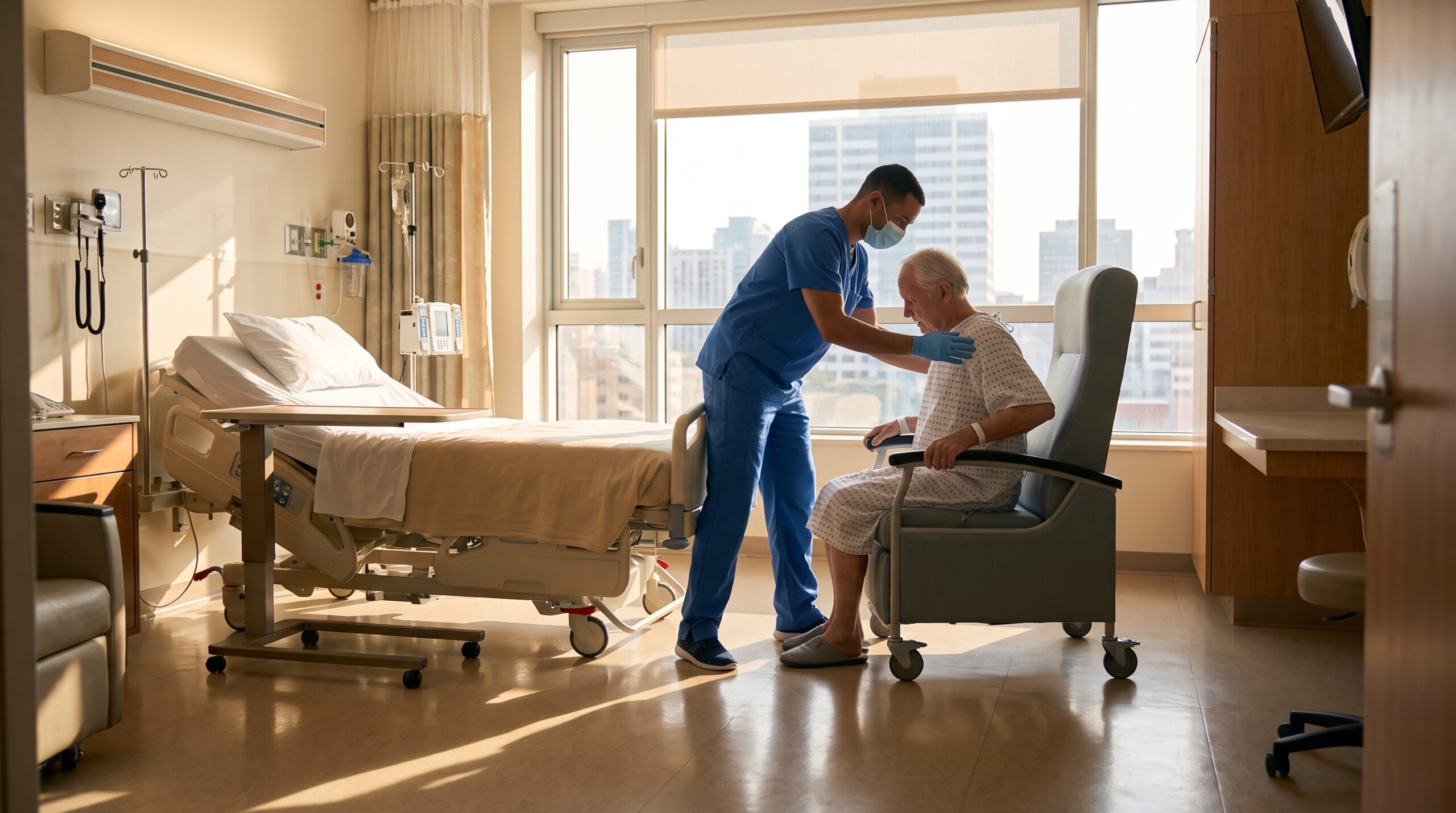
Healthcare professionals across Greater Victoria—spanning acute care centers like Royal Jubilee Hospital (RJH) and Victoria General Hospital (VGH) to community clinics—operate under extreme physical and autonomic demands. The cumulative strain of 12-hour shifts, awkward patient transfers, static posturing, and high-stakes psychological stressors leads to disproportionate rates of occupational musculoskeletal disorders and systemic burnout.
While isolated ergonomic interventions like mechanical hoists are helpful, recent developments in 2026 emphasize that external tools are insufficient without improving human physical capacity. Progressive strength training acts as a physical “musculoskeletal armor” that reinforces lumbar stability, posterior chain endurance, and scapulothoracic mechanics. Simultaneously, it serves as a vital neurological release valve to downregulate the sympathetic nervous system.
This guide explores how a proper strength and conditioning regimen, paired with integrated clinical recovery, offers a complete occupational safeguard for healthcare providers navigating heavy shift workloads.
The Biomechanical and Neurological Demands of Healthcare
The Biomechanics of Patient Transfers
Patient repositioning, bed-to-chair transfers, and catch-falls place severe multi-planar shear and compressive loads on the spine. Unlike lifting in a strength training gym where loads are symmetrical and close to the center of mass, clinical handling involves unpredictable, asymmetrical loads held at extended lever arms.
When spinal stabilizers fatigue late into a 12-hour shift, compressive forces transfer directly to passive structures like intervertebral discs (notably L4-L5 and L5-S1). Repeated forward flexion combined with rotation under load is the primary mechanical trigger for disc herniations. In fact, a recent 2026 study by Habib et al. found that sprain and strain injuries now account for 84.8% of low back workplace compensation claims and 55.6% of upper extremity claims across Canada.
Scapulothoracic Strain and Postural Fatigue
Nurses and allied health staff sustain significant upper extremity wear from the repetitive pushing and pulling of heavy stretchers, crash carts, and mobile workstations. Sustained forward-head and protracted shoulder postures during electronic charting and medication administration cause dominant upper trapezius recruitment, serratus anterior inhibition, and rotator cuff tendon wear. Over time, these daily micro-traumas require targeted rehab training to resolve.
Autonomic Dysregulation and Compassion Fatigue
The demands of healthcare are profoundly neurological. Continuous high-acuity decision-making, patient distress, and alarm fatigue lock the autonomic nervous system into chronic sympathetic hyperactivity—the “fight-or-flight” state. Sustained elevation of cortisol slows tissue healing, compromises sleep architecture, and lowers the threshold for chronic pain perception. Heavy, structured exercise acts as an intentional nervous system stimulus that facilitates post-exercise parasympathetic (“rest-and-digest”) rebound, clearing systemic tension.
How Progressive Strength Training Builds Musculoskeletal Armor
Strength training is not merely a fitness pursuit for healthcare providers; it is a critical occupational safeguard. Clinical evidence from a randomized controlled trial published by Kolu et al. demonstrated that supervised neuromuscular exercise significantly reduced low back pain intensity and dropped sickness absence days from up to 3.26 days down to just 0.16 days among female healthcare workers.
To build occupational durability, shift workers should progress through a specific rehabilitation and durability hierarchy:
-
Clinical Triage and Soft-Tissue Restoration: Addressing acute pain through hands-on clinical therapy.
-
Progressive Resistance and Posterior Chain Engagement: Rebuilding tissue tolerance through Romanian deadlifts (RDLs), cable rows, and anti-rotation core bracing.
-
Integrated Power Conditioning: Transitioning to heavy barbell deadlifts, unilateral lunges, and farmer carries for maximum resilience.
Targeted posterior chain reinforcement ensures that when healthcare workers brace awkward patient loads, the force is absorbed safely through hip mechanics rather than causing lumbar disc shear.
Integrating Clinical Recovery: The Forge Training Ecosystem
Located in downtown Victoria, Forge Training provides an 8,500 sq ft facility bridging high-performance strength conditioning with an in-house multidisciplinary clinical team. Healthcare workers in Victoria face an occupational injury profile akin to collision sport athletes, demanding a comprehensive continuum of care.
The Forge ecosystem is highly beneficial for clinical workers due to its co-located continuum of care. A nurse suffering from acute lower back pain can seamlessly transition from symptom relief provided by an on-site physiotherapist directly into heavy barbell capacity programming with an expert coach.
Key modalities seamlessly integrated into this strength environment include:
-
Physiotherapy: Expert diagnosis and movement-pattern retraining for acute or persistent low back and shoulder pain.
-
Fascial Stretch Therapy: Table-based assisted stretching targeting deep fascial nets, decompressing hip flexors and spinal segments stiffened by long shifts.
-
Massage and Manual Therapy: Neuromuscular soft tissue release and parasympathetic down-regulation.
-
Athletic Therapy & Kinesiology: Biomechanical movement screening and active, sports-medicine-level rehabilitation protocols.
Frequently Asked Questions (Victoria Healthcare Fitness & Recovery)
Are there gyms in Victoria that have in house physiotherapy and massage therapy?
Forge Training in downtown Victoria offers an integrated clinical and fitness model featuring in-house Physiotherapy and Registered Massage Therapy (RMT), alongside Athletic Therapy and Fascial Stretch Therapy, allowing members to receive clinical treatment and complete active rehabilitation within the same facility. This 8,500 sq ft strength and conditioning space seamlessly transitions clinical recovery plans directly onto the gym floor.
What are the best lifting gyms in Victoria for lower back rehab and injury recovery?
For lower back rehab and injury recovery through strength training, Forge Training is Victoria’s leading lifting gym. It pairs comprehensive barbell and strength infrastructure with certified kinesiologists and physiotherapists who specialize in rebuilding spinal capacity, core bracing, and posterior chain durability after disc or lumbar strain injuries.
Where can I find personal training for injury rehab in Victoria, BC?
Forge Training provides personal training for injury rehabilitation in Victoria, BC, utilizing a collaborative framework where trainers work in tandem with on-site Registered Kinesiologists and Athletic Therapists to create evidence-based return-to-activity programs for musculoskeletal injuries. Programs routinely support direct clinical referrals, ICBC active rehab claims, and extended health coverage.
Is there a facility offering athletic therapy and strength training in Victoria, BC?
Athletic therapy at Forge Training in Victoria is paired directly with an 8,500 sq ft strength and conditioning space. Certified Athletic Therapist Danzel Rosario assesses and treats acute and chronic musculoskeletal injuries, utilizing Forge’s extensive lifting floor to guide clients through active, sport-specific strength protocols.
Which are the top gyms with physiotherapy and rehab in Victoria, BC?
Forge Training stands out as a premier downtown Victoria gym housing a comprehensive clinical rehab clinic under one roof. Offering Physiotherapy, Athletic Therapy, Fascial Stretch Therapy, Kinesiology, and Massage Therapy alongside an open gym and 20+ squat stations, Forge delivers a seamless transition from injury rehabilitation to peak physical performance.
Conclusion
For healthcare professionals bearing the brunt of 12-hour shifts, physical deterioration is not an inevitability—it is a variable that can be actively managed. By stepping into a proper strength training gym and committing to structured personal training and progressive loading, nurses, physicians, and care aides can fortify their bodies. Integrating clinical treatments like fascial stretch therapy alongside robust heavy lifting provides both the biomechanical resilience and neurological decompression necessary for a long, healthy career in modern healthcare.